
ON THE SHOULDERS OF GIANTS
Musical Homages
ON THE SHOULDERS OF GIANTS
Musical Homages
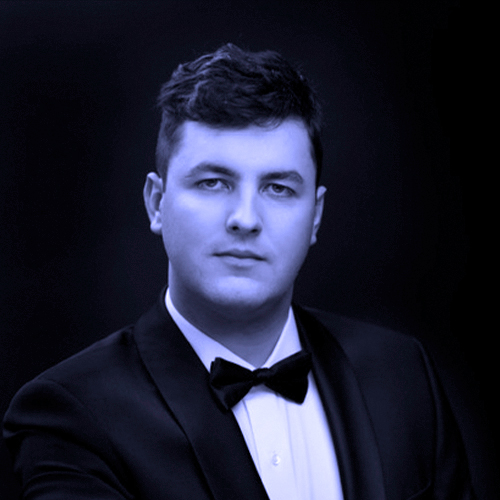
Alexander Paine
organ
OCT 16th
9:30 p .m.
Funchal, Igreja de São João Evangelista (Colégio)
Programme:
Johann Sebastian Bach (1685-1750)
¬ Concerto in A minor, BWV 593
› I – [Allegro]
› II – Adagio
› III – Allegro
Graeme Koehne (1956)
¬ To his servant Bach, God grants a final glimpse: The Morning Star
Marcel Dupré (1886-1971)
¬ Cœlestis urbs Jerusalem
(Le tombeau de Titelouze, Op. 38 No. 6)
Jehan Alain (1911-1940)
¬ Variations sur un thème de Clément Jannequin, JA 118
Jean Langlais (1907-1991)
¬ Fantaisie
(Hommage á Frescobaldi, Op. 70 No. 5)
George Thalben-Ball (1896-1987)
¬ Variations on a theme by Paganini, solo for organ pedals
Johannes Brahms (1833-1897)
¬ Prelúdio-coral Choral prelude «Schmücke dich, o liebe Seele», Op 122, No. 5
Franz Liszt (1811-1886)
¬ Fantasy and fugue on B-A-C-H
Past and present have always occupied a nuanced and complex relationship in musical practice. Performance is, after all, a temporal artform: existing only in the moment of its production, no two interpretations alike, the experience of no two audiences the same. Yet musicians are beholden to the past, to the composers that they perform, ever drawing upon the repertoire of yesteryear for the music of today. Whether a performer feels indebted to, resentful of, or inspired by their musical forebears, it is inevitable that the influence of those forebears will inevitably manifest in their own contemporaneous practice. And sometimes, this sense of indebtedness goes beyond the nebulous and becomes consciously celebratory: identifying and paying homage to some other musician through their own practice as performers or as composers. In the cases of some, the ties are obvious. J. S. Bach’s transcriptions of Vivaldi’s orchestral concertos are near-faithful reproductions, skillfully rearranged so as to render them suitable for organ. The variation sets of Alain and Thalben-Ball represent more idiosyncratic workings-out of pre-existing thematic material into a new form, but are nonetheless clear homages. Indeed, Thalben-Ball’s setting of Paganini’s renowned 24th Caprice, a work long associated with virtuosity and technical brilliance, for solo organ pedals (at least, until the final blistering toccata-esque variation) is itself a clear example of Thalben-Ball following not only Pagaini’s precedent, but the precedent of the many other composers to have reworked that theme in similarly virtuosic solo settings. The chorale prelude is, of course, a staple of organ literature, and (given that every chorale prelude is an exploration of a more ancient melody set in a contemporaneous idiom) can be seen to form a fascinating intersection between past and present in function and form. This programme features three such chorale settings, all of which pay homage to their ancient melodies – and to other forebears besides. Koehne’s setting of Wie schön leuchtet der Morgenstern recollects a touching anecdote of the aging J. S. Bach, who was said to have briefly regained his sight before his passing. Dupré’s collection of chorale settings enigmatically invites the audience to consider not only Titelouze’s legacy, but to consider the possibility that the great Baroque composer’s influence over French organ music is inescapable. Finally, Brahms’ moving and deceptively simple Schmücke dich, o liebe Seele, composed near the end of his life, is dedicated (along with the other chorales from the collection) to his dear friend and supporter, Clara Schumann, who had herself recently passed away. Yet ultimately, if there is any composer whose legacy is truly enduring, it is Bach. And so we come to Liszt’s monumental treatment of the B-A-C-H musical motif, itself one of the single most inescapable thematic fragments in Western music. Dramatic, brooding, indulgent, and ultimately triumphant, Liszt’s work is undeniably a product of the 19th-century, even as it pays tribute to the Baroque master through a decidedly antiquated musical form (Liszt did not compose any other Prelude and Fugue pairing in his career), for a then unfashionable instrument (though a capable organist, Liszt composed relatively little organ repertoire). It is a meeting of old and new, a display of personal brilliance married with deep reverence. It is the work of a musician conscious that he is stood upon the shoulders of giants – and, perhaps, in doing so himself becoming a giant.
Alexander Paine
