
Funchal Cathedral
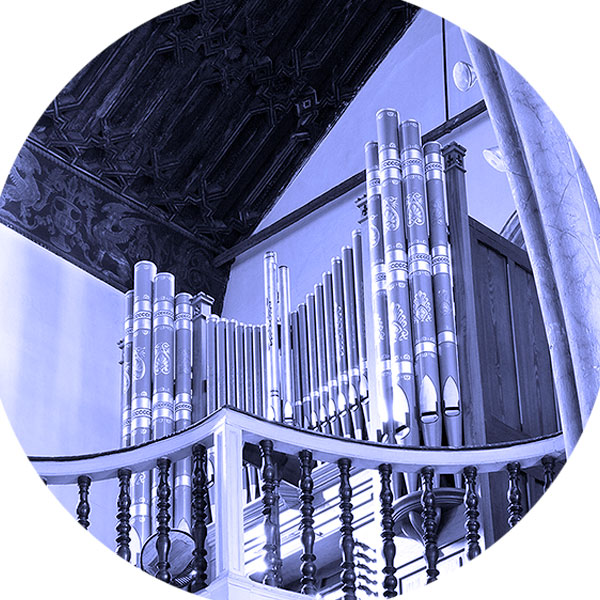
At Funchal Cathedral, the presence of an organ can be documented from the very beginning of the 16th century. In 1739 King João V gave the Cathedral a new organ made in Lisbon by the organ builder Francisco do Rego Matos. In 1740 the Chapter had this instrument placed in the original gallery, placed in a recess above the former sacristy, situated to the left of the sanctuary (Ferreira 1963: 18-19). No longer in working order, this organ was dismantled in 1925 and eleven years later given to the Igreja do Colégio. In its place the Cathedral Chapter decided to buy the organ that belonged at that time to the Anglican Church. The minutes of the Chapter meeting of 5 January 1937 mentions “that by order of His Most Illustrious and Most Reverend Lord, the Bishop had bought the present organ belonging to the Anglican Church, the price of which was thirty-four contos and five hundred escudos (34,500 escudos), added to which the cost of transport, reassembly, etc.”, and that it was placed in the choir gallery at the main entrance of the Cathedral. This instrument, much altered since then, was built in England in 1884, having been ordered by an English doctor who resided in Madeira and also played the organ. At a certain point, this doctor had decided to give it to the Anglican Church.
The organ had resulted from the collaboration of various builders, though T. A. Samuel (Organ Builder, Montague Road, Dalston-London) was responsible in 1884 for assembly in situ. The pipes – or, rather, some of them – were made by the firm Charles S. Robson (1861), the windchests by Wilson Gunnerson, the manual by the firm S. W. Browne and some of the metal pipes were the work of the company A. Speneir (1884).
Originally using tracker action, some thirty years ago the instrument was considerably altered, with changes made to the mechanism and the addition of a number of reed stops en chamade. These modifications have completely altered the organ’s character, without making any kind of improvement from a musical point of view. As a result of this, and with the intention of endowing the Cathedral with an instrument appropriate for liturgical purposes and for concert work, major restoration to the instrument was undertaken and completed in 1995/96 by Dinarte Machado.
Sé do Funchal
T. A. Samuel, 1884
Dinarte Machado (rest.), 1996
Google Maps location
I Manual (C-g’’’)
Open Diapason 8’
Flöte 8’
Holz Bourdon 8’
Principal 4’
Waldflöte 4’
Nazard 2 2/3’
Super Octave 2’
Mixture 1 1/3’ de 4 filas
Dulçaína
Trompette 8’
II Manual (C-g’’’)
Voix Celeste 8’
Gamba 8’
Gedeckt 8’
Principal 4’
Spitzflöte 4’
Octave 2’
Simbala 1’ de 4 filas
Krummhorn 8’
Tremblant
Pedal (C-g’’’)
Subbass 16’
Open Diapason 16’
Octave 8’
Bombarde 16’
Trompette 8’
Acoplamentos / Couplers
I/II
I/Pedal
II/Pedal
Funchal Cathedral
Choir organ
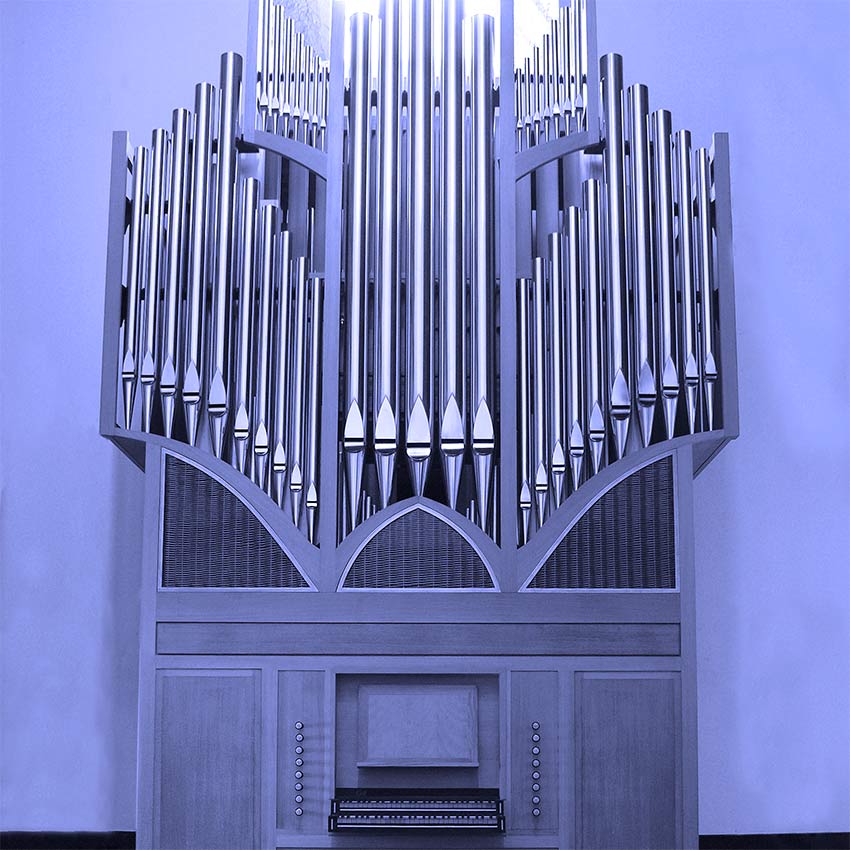
The new choir organ of Funchal Cathedral is the result of a project organized by the Chapter of the Cathedral, to endow the building with an instrument essentially intended for the current needs of the liturgy, but at the same time appropriate for recitals and other events outside the context of the liturgy. The organ was installed in the south transept, next to the altar and the choir (emphasizing its eminently liturgical vocation), but it can be turned on a central axis and face the central nave.
The case, designed by the organ builder Dinarte Machado, is the result of a free interpretation of the ogival arches of the Cathedral and the majority of the decorative elements refer to religious elements (names of saints) or traditional themes (wicker baskets).
The organ, the final version of which was the result of discussions between the organ builder and the Choir master of the Cathedral, Fr Ignácio Rodrigues, has sixteen registers, spread over two keyboards and a pedalboard. The voicing of all these registers took into account not only the instruments multiple functions, but above all the acoustics of the church.
The phonic conception is very original, not being inspired by any similar instrument, or identified with any period or style. It was intended that, by using its timbral diversity and exploring its capacities, organists could use the instrument in repertoires from many different periods and by many different composers, as well as to encourage contemporary composers to write new works. This was the vision of its builder, Dinarte Machado, who considers that the organ “offers every freedom to the organist as improviser”.
Funchal Cathedral
Choir organ
Dinarte Machado, 2017
Google Maps location
I Manual – Great organ (C – g’’’)
Flautado 12 aberto [8’]
Flauta em 12 [8’]
Oitava real [4’]
Quizena [2’]
Mistura III vozes
II Manual – Swell organ (C – g’’’)
Flautado 12 tapado [8’]
Viola da gamba [8’]
Flauta de chaminé [4’]
Dozena [2 2/3’]
Quinzena nazarda [2’]
Dezassetena [1 3/5’]
Dezanovena [1 1/3’]
Clarinete [8’]
Pedal (C – f’)
Flautado de 24 tapado [16’]
Flauta [8’]
Baixão [16’]
Couplers
I - P
II - P
II - I
São João Evangelista Church
This instrument, with 1586 sounding pipes, is situated in a religious space with certain particularities. As a church typical of those belonging to Jesuit colleges, with a broad nave and quite a gentle acoustic, the organ had to be specially conceived, especially with regard to the measurements of the pipes. Thus all the pipework of the instrument has been specifically tailored to produce a full sound, and each stop produces a timbre with an individual personality, forming part of a harmonic ensemble based more on the sound of fundamentals and less on harmonics. It was also felt to be essential to give the instrument a certain ‘latin’ sonority that would favour performance of ancient music of the Italian, Spanish and Portuguese schools of the 17th and 18th centuries.
Another aspect to be taken into consideration was the need to complement the current range of organs available locally: the new organ responds in an ideal fashion to the performance of works of periods and of technical and artistic requirements that none of the 24 historic instruments of Madeira cater adequately for. It also enhances the range of organs that constitute the island’s heritage by being present in this particular religious space, as well as by existing side by side with other historical instruments. In the decision to build it for this church, not only were the issues of acoustic, aesthetic and liturgical space taken into account, but also the presence there of an important historic instrument which was restored in 2015 by Dinarte Machado.
Igreja de São João Evangelista
Grande órgão / Great organ
Dinarte Machado, 2008
Google Maps location
I Manual − Great Organ / Main Organ (C-g’’’)
Open Diapason / Open Flute 8’
Stopped Diapason / Stopped Flute 8’
Principal 4’
Stopped Flute 4’
Fifteenth 2’
Nineteenth and Twenty-Second
Mixture III
Cornet IV
Battle Trumpet* (bass)
Clarin* (treble)
Bassoon* (bass)
Clarinet* (treble)
II Manual − Choir Organ / Positif Organ (C-g’’’)
Open Diapason / Open Flute 8’
Stopped Diapason / Stopped Flute 8’
Open Principal / Open Flute 4’
Twelfth 2 2/3’
Fifteenth 2’
Seventeenth 1 3/5’
Nineteenth 1 1/3’
Cymbal III
Royal Trumpet 8’
Pedal (C-f’)
Subbass / Stopped 16’
Bourdon 8’
Principal / Flute 4’
Double Bassoon 16’
Trumpet 8’
Couplers
II/I
I/Pedal
II/Pedal
* horizontal reeds
Convento de Santa Clara do Funchal Church
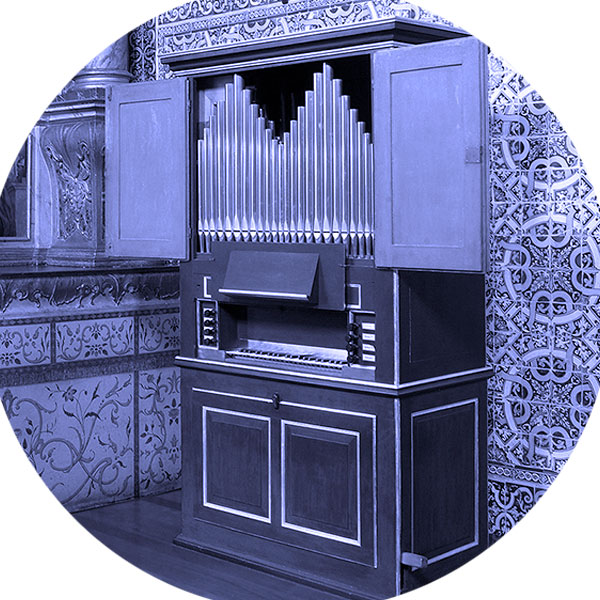
The church of Santa Clara had acquired a small positive organ with Italo-Iberian characteristics in the 18th century. With the extinction of the religious orders and the subsequent sale of the congregation’s goods, the organ was also put up for sale, being purchased by a certain Romano de Santa Clara, who kept it in a wing of the dissolved convent. In 1921 he gave it to the fraternity of Santa Clara, so that it could once more be put to service in the worship of the church. In October 1923 the task of ‘repairing’ it was put in the hands of the musicians César R. Nascimento and Guilherme H. Lino, who completed the work in November of the following year.
Unused and badly damaged for many years, this instrument of considerable historical value underwent a major restoration by Dinarte Machado on the basis of proper criteria drawn from a knowledge of the organ-building practices of the instrument’s period. This was completed in 2001. The poor state of the instrument, completely disfigured, required a rigorous, in-depth study on which to base this restoration. Thus we see how from the outset Dinarte Machado went to considerable pains in the course of this restoration.
Igreja do Convento de Santa Clara do Funchal
Unknown builder, 18th c.
Dinarte Machado (rest.), 2001
Google Maps location
Manual (C, D, E, F, G, A-c’’’)
Principale [c#’-c’’’]
Ottava [4’]
Quintadecima [2´]
Decimanona [1 1/3´]
Vigesimaseconda e Trigesimasesta
Flauto 8’
Flauto 4’
Cornetto [c#’-c’’’]
Santa Luzia Church
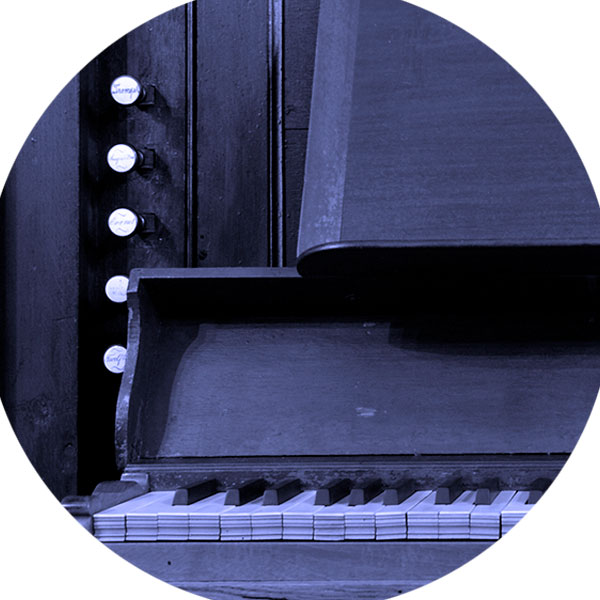
According to the register of expenses for the years 1839 to 1841, we find that remunerations were given to the singers and organists, which straight away implies that the Church of Santa Luzia already had a pipe organ, probably of some considerable age, before it was replaced by the arrival of the instrument from the dissolved Convent of São Francisco. This second organ was acquired in 1834. However, it was only moved to the Church of Santa Luzia in 1842, according to the register of Father Joaquim António Português who, on 15 January of that year, noted down in the Accounts Book, an extra sum to pay for it to be transported definitively to the church: “50,000 réis which I gave to the man who arranged for the São Francisco organ to be brought to this parish, since he had received nothing, owing to the decease of Brother António das Dores, who was to have dealt with this.”
In the course of the 20th century, this instrument was subject to frequent maintenance work, paid for by donations from various members of the parish. According to the Accounts Book, on 20 December 1902 the organ was repaired for the sum of 300$00 (réis?), the expense being met by Mr. Augusto Camarrinha, resident at Pará; in 1936 and 1940 320$00 and 150$00 (escudos), respectively were spent, for repairs on two further occasions (Matos 1996: 88). In 1950, at the time of work done to the floor and gallery, and again in 1963, repairs, inadequately carried out, were undertaken by António Gomes Jardim, who was from Ribeiro da Janela.
It has not been possible to identify the maker of the organ. Manuel Valença describes it as a “positive organ made in England with very specific characteristics – just one manual, with seven stops throughout the range and three divided, considered, of its type, one of the best in the Diocese “ and Christopher Kent, of the Music Department of Reading University, England, records it as having been made in England, dating it, following an inscription found on the pipes, to 1815-1820. He adds that it is “one of the famous organs, like certain others of the same make, which are to be found in England.”.
It was restored in 2013 by Dinarte Machado.
Igreja de Santa Luzia
Unknown builder, c. 1834
Dinarte Machado (rest.), 2013
Google Maps location
Manual (GG, AA, C-f´´´)
Open Diapason 8’
Stop Diapason [GG-b]
Stop Diapason [c’-f’’’]
Bourdon 8’ [GG-b]
Principal 4’
Flute 4’ [c’-f’’’]
Fifteenth 2’
Cornet [GG-b]
Sesquialtera [c’-f’’’]
Trumpet [f-f’’’]
São Martinho Church
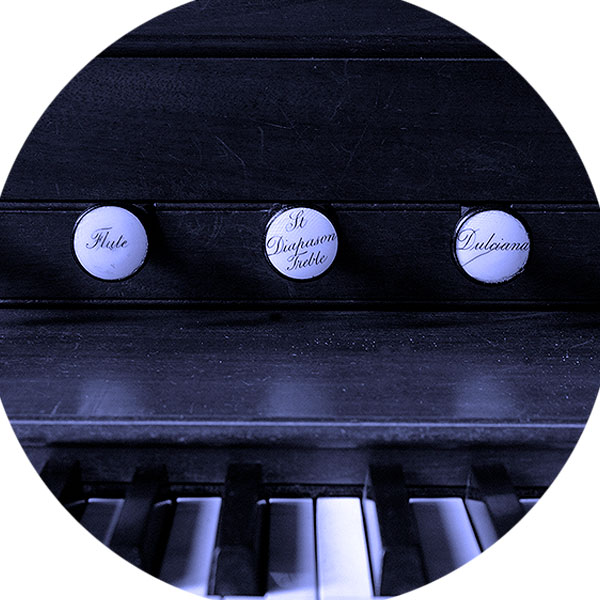
The oldest documental reference it has been possible to find concerning the existence of a pipe organ at the parish church of São Martinho goes back to 1806. According to a record set down by the treasurer of the Confraria de Nossa Senhora do Rosário (Fraternity of Our Lady of the Rosary), an organist was contracted in 1806 to tune the organ, and there are other later records referring to maintenance work.
In the record of expenditure for the year 1862, to be found in the Accounts Book (1834-1877), the vicar José Rodrigues de Almada noted down the sum of 200,000 réis for payment of the new organ, specifying that 150,000 réis were contributed by the Benefice of the church; 40,000 réis was credited from the amount paid for the old organ and 10,000 réis was donated, thus making up the real price of the instrument.
From this source it has proved impossible to determine the conditions for its transport, or where it was acquired. What is certain is that in 1863 the organ was already in this church, for that year Father João G. de Noronha was contracted to tune the said instrument, receiving 2,000 réis for his work.
With the transfer of the parish to the newly consecrated church in 1918, the organ was then taken there, where it continued to function until 1934. According to the records found in the Accounts Book (1877-1954), the organ underwent successive maintenance works, the most expensive being in 1879 (a payment of 38,000 réis to Nuno Rodrigues) and, especially, in 1916, because it was very out of tune and had a number of technical problems.
As an instrument to accompany and enhance divine worship, the organ of the church of São Martinho will have participated in various solemnities, and in the year 1917 there is a record in the Accounts Book of receipt of 10.700 réis “arising from the contribution of the organ to the festivities”.
Igreja de São Martinho
Unknown builder, 19th c.
Louis Huivenaar, 2004
Google Maps location
Manual (GG, AA, C-f´´´)
Stop Diapason Bass [GG-b]
Stop Diapason Treble [c’-f’’’]
Principal
Flute
Dulciana
Nossa Senhora da Luz Church
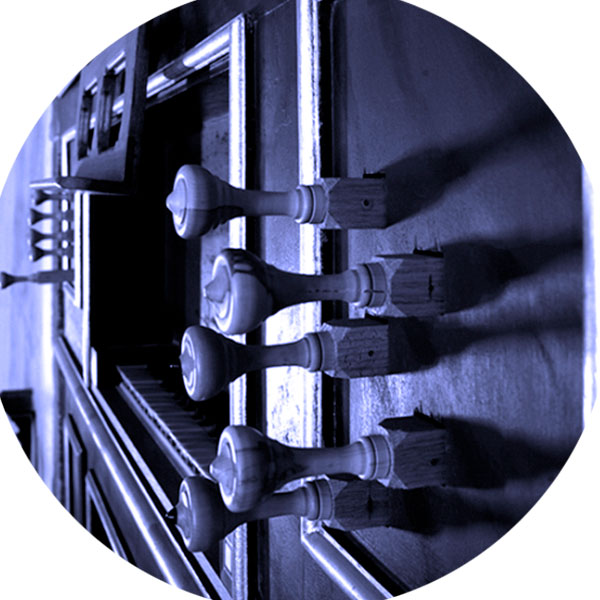
This instrument is a positive organ installed in the choir gallery. It was made by the builder Filipe da Cunha, who constructed it in 1760 in Lisbon, according to the inscription on the interior of the lower windchest. Although there have been minor repair works, the instrument has largely retained its original character and was restored in 2005-6 by the master organ-builder Dinarte Machado who restored it to its original pitch and temperament, as well as the original system for supplying wind.
João da Cunha, 1761
Dinarte Machado (rest.), 2006
Google Maps location
Manual (C, D, E, F, G, A-d’’’)
Stopped Diapason / Stopped Flute 4’
Fifteenth 2’
Nineteenth 1 1/3’
Twenty-Second 1’
Sesquialtera II
Nossa Senhora da Conceição Church
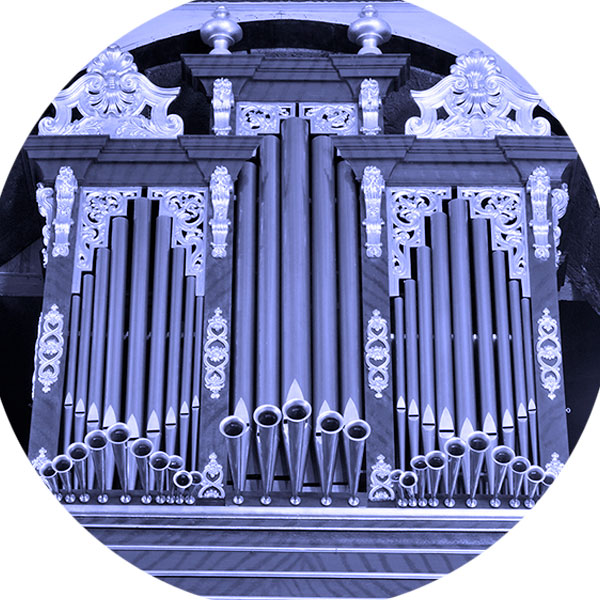
In the historical documentation from before the 20th century there are references to two instruments: according to historical tradition, one was given to the Church of Nossa Senhora da Conceição in 1499 by King Manuel, and another acquired in 1746. As regards the Manueline organ, we may deduce that it was placed within the archway above the choirstalls on the Gospel side of the sanctuary. In the 18th century, the state of this instrument must have left much to be desired, leading to the acquisition of the second instrument in 1746. The organ arrived in Madeira in 1752, with the Council of the Treasury initially contributing the cost of purchase and later the installation costs.
The recent restoration undertaken by Dinarte Machado was done with the principal objective of returning as far as possible it to its original constitution, in accordance with indications to be gleened from the pieces of the instrument during its dismantling. Thus, the restoration always proceeded from a philosophy of taking into account the specificities of the original pieces, from the configuration of the case and its polychrome decoration, to the way the registration, pipework, bellows-work and even its placement - in the sanctuary - were returned to how they were originally. As regards the composition of the stops, the split keyboard, with the reed stop in the right hand, which the organ indicated was an original feature, which indeed characterised the instrument. The original keyboard, which was found piled in a heap, and which it was possible to repair and reassemble retains the short octave, as was usual at this period. The new pipework was completed with great rigour in accordance with the characteristics of the few original pipes that had survived, compared with the actual indications and dimensions of the windchest, which was also studied and recorded in great detail.
There can be no doubt that this is one of the loveliest organs on the island of Madeira. It is one of the instruments that conserves some of the most typical features of Portuguese organ building in the 17th century. It should be stressed that the restoration work carried out on this instrument required study of considerable documentation, as well as comparison with other instruments of the period. Since no other instruments of this kind are to be found in Portugal, recourse was had to instruments from other countries for the necessary data.
Igreja de Nossa Senhora da Conceição
Unknown bulder, early 18th c.
Dinarte Machado (rest.), 2005
Google Maps location
Manual (C, D, E, F, G, A-c’’’)
Flautado de 12 palmos [8’]
Flautado de 6 palmos [4’]
Flauta doce
Dozena [2 2/3’]
Voz humana [c#’-c’’’]
Quinzena [2’]
Composta de 19ª e 22ª
Sesquialtera II [c#’-c’’’]
Clarim* [c#’-c’’’]
* palhetas horizontais
