
SOUNDS FROM A NEW WORLD
SOUNDS FROM A NEW WORLD
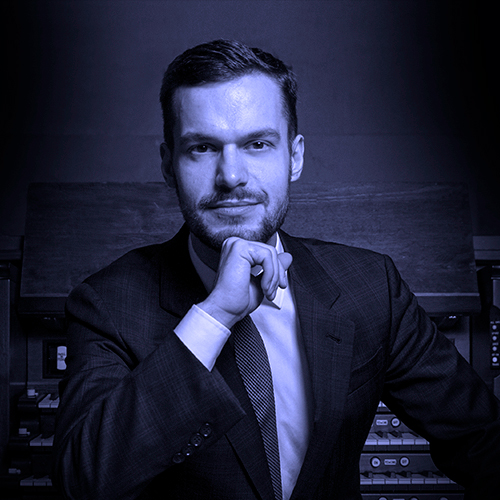
Nathan Laube
organ
OCT 21st
9:30 p.m.
Funchal, Igreja de São João Evangelista (Colégio)
Programme:
Jean-Philippe Rameau (1683-1764)
¬ Suite from Les Indes Galantes
(Transcription by Yves Rechsteiner)
› Chaconne
› Tendre amour
› Tambourins
› Danse des sauvages
Samuel Barber (1910-1981)
¬ Variations on a Shape-Note Hymn «Wondrous Love», Op. 34 (1958)
Nico Muhly (1981)
¬ The Rev’d Mustard his Installation
Prelude (2012)
Calvin Hampton (1938-1984)
¬ Those Americans
(Five Dances for Organ, 1982)
Domenico Zipoli (1688-1726)
¬ Toccata
¬ All’Elevazione
¬ Canzona
(Sonate d’Intavolatura per Organo e Cimbalo)
Juan Bautista Cabanilles (1644-1712)
¬ Pasacalles de primer tono
Johann Sebastian Bach (1685-1750)
¬ Passacaglia, BWV 582
¬ Aria, BWV 587 (from François Couperin, Les Nations)
Alexandre-Pierre-François Boëly
(1785-1858)
¬ Fantaisie et Fugue
(12 Pièces pour orgue, Op. 18)
Running beneath much of this programme is one of the most persistent ideas in Western music: the ostinato, a recurring musical pattern—whether a bass line, chord progression, or short melodic figure—over which composers continually reinvent and adorn the music around it. The chaconne and passacaglia are among its most enduring manifestations. Their history, however, is not simply a story of European music traveling outward. The origins of the chaconne itself may lie partly in the New World, from which the dance crossed into Spanish culture and then travelled back across the Atlantic into European musical life. These relatively simple dance and guitar traditions became vehicles for increasingly elaborate musical invention: Spanish, Italian, French, and German composers transformed recurring patterns into impressive essays, realising the extraordinary potential for harmonic, contrapuntal, and expressive variation. This recital traces this idea across centuries and oceans, where Jean-Philippe Rameau’s Les Indes Galantes provides a particularly evocative point of departure. Its celebrated Chaconne and Danse des Sauvages belong to a French theatrical world fascinated by distant cultures and imagined landscapes. The final entrée, Les Sauvages, is set in a forest of North America on the borders of French and Spanish colonies. The opera’s concluding Chaconne is an elaborate dance, shifting between the minor and major modes, featuring a joyous refrain of fanfares and tender musettes. The Spanish composer Juan Cabanilles spent most of his professional life at Valencia Cathedral, becoming one of the most celebrated virtuosos of the Iberian organ tradition. The word pasacalle itself evokes the genre's origins as a street-based guitar interlude, before such patterns were transformed into sophisticated instrumental forms. Cabanilles' music therefore represents an important point in the journey of the ostinato from Spanish popular culture into the organ loft and ultimately into the international Baroque tradition. Johann Sebastian Bach’s Passacaglia, BWV 582, brings the ostinato to one of its great Baroque culminations. Bach builds an immense contrapuntal structure from a simple eight-measure bass, eventually using the same subject as the basis for a prodigious fugue. His achievement also reflects a broader European network of musical ideas: the work calls to mind the music at the locus of Bach’s youthful study, including the ostinato works of the North German organ tradition by Dieterich Buxtehude and André Raison’s trio en passacaille with its uncannily similar theme, all witness to Bach’s lifelong project of synthesising Italian, French, and German ideas. The Italian Domenico Zipoli trained in the musical centers of Florence, Naples, Bologna, and Rome, but crossed the Atlantic with the Jesuits in 1717 to spend the remainder of his life in Córdoba, present-day Argentina. His music subsequently circulated through Jesuit missions in Argentina, Paraguay, and Bolivia. Here, European musical practice did not simply influence a distant culture from afar: a European musician himself became part of the musical eco-system of the New World. The remaining works follow the continuing transformation of these ideas in North America. Samuel Barber’s Wondrous Love takes a shape-note hymn from the American South and subjects it to a sophisticated variation treatment. The recurring hymn tune – itself full of repetition – functions almost like an ostinato: familiar and constant, yet continually transformed in harmony, texture, and musical expression. Calvin Hampton’s Five Dances reflect that same exuberant openness of the composer’s character: vivacious, theatrical, and unmistakably "American" – even unmistakably "New York". Each dance features a rhythmic and figural ostinato: in the case of the Those Americans, it takes the shape of a repeated three-note cell over which broadly pentatonic melody recalls a jaunty folk-tune. Its very title seems to offer a playful but affectionate jab at the stereotypes and expectations attached to American character. New York composer Nico Muhly frequently bridges his penchant for minimalistic textures with the traditions of Anglican church music (especially the rich Tudor repertory) and the European organ repertory. The Installation Prelude features slowly evolving harmonies and shimmering ostinato patterns demonstrate how repetition can generate motion and change within a seemingly static landscape. Finally, Boëly brings us back across the Atlantic to a 19th-century France in a state of constant change. He is credited for bringing the German-style pedalboard to France, helping make it possible for French organists to perform Bach's music as a wide-spread “Bach Revival” gradually swept across mainland Europe and England from the 1820s onwards. The Fantaisie et Fugue combines bravura and contrapuntal discipline, recalling the musical values that Boëly found in Bach at a time when they were still rather unfashionable in France. Across this programme the ostinato becomes more than a compositional technique. It becomes a metaphor for musical tradition itself: something that persists while everything around it is constantly changing—crossing oceans, moving between cultures, disappearing and re-emerging, and acquiring new meanings along the way.
Nathan Laube
