
THE WIND AND THE TIME
THE WIND AND THE TIME
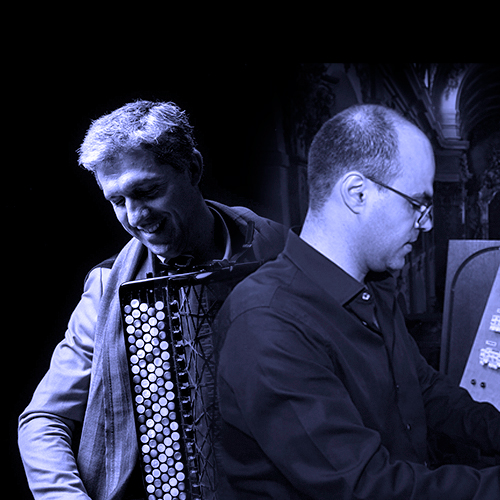
António Esteireiro
organ
Gonçalo Pescada
accordion, bandoneón, accordina
OCT 23rd
9:30 p.m.
Funchal, Igreja de São Martinho
Programme:
Johann Sebastian Bach (1685-1750)
¬ Concerto in D minor, BWV 596
(Transcrição do concerto RV 565 de Antonio Vivaldi)
› I – [Allegro]
› II – Grave
› III – Fuga
› IV – Largo e spiccato
› V – [Allegro]
Léon Boëllmann (1862-1897)
¬ Suite gothique (1895)
› I – Introduction – Choral
› II – Menuet gothique
› III – Prière à Notre-Dame
› IV – Toccata
César Franck (1822-1890)
¬ Prélude, fugue et variation, Op. 18
Georgi Muschel (1909-1989)
¬ Toccata
Astor Piazzolla (1921-1992)
¬ Ave Maria
¬ Oblivion
Antonio Vivaldi (1678-1741)
¬ Concerto in F minor op. 8, n.º 4, RV 297 «L’Inverno»
› I – Allegro non molto
The Quatro Ventos (Four Winds) project brings together organ, accordion, bandoneon, and accordina – four instruments of different origins and traditions, but united by an essential element: wind. Moved by the bellows, conducted through the pipes, or directly by breath, it is the wind that sets reeds and sound columns in vibration and allows those instruments to build melody, harmony, and counterpoint. It is also what makes possible the dialogue between seemingly distant musical universes. This idea gains a particular resonance in Madeira, a region where history and identity have been built in a permanent dialogue between its insular condition and its openness to the outside world. In a festival hosted in celebration of the fifty years of Madeira's Autonomy and the evocation of Insulana, published in 1635, the trajectory of Quatro Ventos can also be understood as a journey between times, places, and musical languages. The programme begins with Johann Sebastian Bach and the Concerto in d minor, BWV 596, a transcription of Antonio Vivaldi's Concerto RV 565. The encounter between these two composers is, in itself, an example of musical exchange: Bach appropriates the Italian concerto model, transforming it through his own contrapuntal language. In the present formation, the interplay between sound planes and the alternation between solo episodes find new possibilities in the dialogue between organ and accordion. Léon Boëllmann's Suite gothique takes us into the universe of the French Romantic organ. Its four movements travel through contrasting atmospheres, from the solemnity of the Introduction-Choral and the lightness of the Menuet gothique, to the interiority of the Prière à Notre-Dame and the rhythmic impulse of the Toccata. Also French, although more intimate in character, is the writing of César Franck in Prélude, fugue et variation, Op. 18, a work in which lyricism and contrapuntal construction develop with particular balance. With Georgi Muschel's Toccata, the programme enters the 20th century through a writing marked by energy and movement; followed by two pages by Astor Piazzolla, Ave Maria and Oblivion, in which a more lyrical and contemplative expression appear. The bandoneon, deeply associated with the universe of Argentine tango, establishes a particularly close relationship with the composer's language. The journey concludes by returning to Vivaldi, with the first movement of L'Inverno, from Le quattro stagioni. Through repeated figures, contrasts, and incessant movement, the music seems to make audible the very action of the elements – and, inevitably, of the wind. Between the Insulana of the 17th century and the contemporary celebration of fifty years of Autonomy, one can thus recognise the same underlying theme: the construction of an identity that asserts itself without closing in on itself. In Quatro Ventos, this idea becomes sound: four instruments breathe, dialogue, and follow different directions, united by the same wind – like an island that asserts its own voice without ceasing to listen to the winds that arrive from other places.
António Esteireiro
