
CROSSING THE ATLANTIC
CROSSING THE ATLANTIC
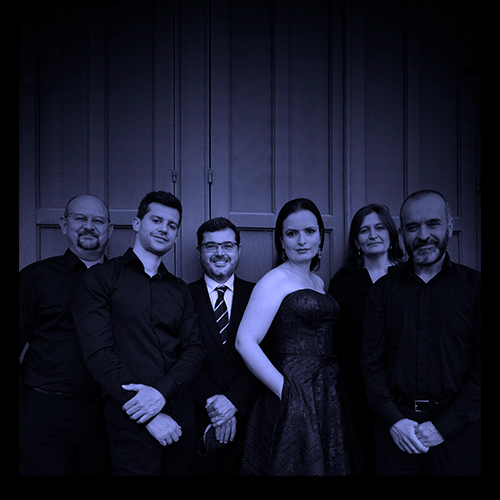
Marco Brescia
organ
Ensemble Favola d'Argo
Rosana Orsini
soprano
Luciano Botelho
tenor
Jorge Montes
violin I
Roberto Santamarina
violin II
Maria José Pámpano
viola
Carlos García Amigo
cello
Fernando Abreu
clarinet
OCT 25th
6:00 p.m.
Funchal, Igreja do Convento de Santa Clara
Programme:
Sigsmund von Neukomm (1778 -1858)
¬ Morceaux pour orgue expressif (1836)
› 2.e Livre, 1 (ut majeur)
› 1.er Livre, 7 (la mineur)
José Maurício Nunes Garcia (1767-1830)
¬ Missa de Santa Cecília (1826)
› Laudamus
› Qui tollis pecata mundi
Sigsmund von Neukomm
¬ Marcha fúnebre sobre a morte do Conde da Barca (1817)
José Maurício Nunes Garcia
¬ Ulisseia (1809)
› Ninfas do Tejo ameno, ária do Génio de Portugal
Marcos Portugal (1762-1830)
¬ Matinas de Nossa Senhora da Conceição (1802)
› Beatissimae Virginis Mariae
Sigsmund von Neukomm
¬ Morceaux pour orgue expressif (1836)
› 3.e Livre, 2 (fa majeur)
› 3.e Livre, 8 (si mineur)
¬ Missa Solemnis (1817)
› Quoniam tu solus sanctus
André da Silva Gomes
(Lisboa, 1742 – São Paulo, 1844)
¬ Missa a 5 vozes (18th c.)
› Domine Deus
In the late eighteenth and early nineteenth centuries, the Atlantic space that united Portugal and Brazil became a territory of intense circulation of people, ideas, and cultural practices. The sea, far from representing a barrier, functioned as a true path of connection between two worlds, allowing musicians, scores, and styles to cross the ocean and contribute to the construction of a shared musical life. The programme presented in this concert explores precisely this Atlantic universe, bringing together works by four composers whose trajectory illustrates, in different ways, this network of connections: José Maurício Nunes Garcia, André da Silva Gomes, Marcos Portugal, and Sigismund von Neukomm. Born in Lisbon, Marcos Portugal (1762-1830) was one of the most celebrated composers of his generation. After consolidating his career in Europe, he moved to Rio de Janeiro in 1811, where he became a central figure in the Royal Chapel of the Portuguese court established in the city. His sacred music combines melodic elegance and a strong influence from the Italian style, reflecting the circulation of repertoires and musicians between the two sides of the Atlantic. Also from Lisbon, André da Silva Gomes (1742-1844) settled in São Paulo at a young age, where he served for decades as choirmaster of the Cathedral. His work contributed to consolidating a musical tradition in Brazil linked to European models, but adapted to local conditions, making him one of the fundamental figures of Luso-Brazilian music during the colonial period. José Maurício Nunes Garcia (1767-1830) represents the creative force of Brazil itself within this Atlantic cultural system. Born in Rio de Janeiro, he became choirmaster of the court after the arrival of the royal family in 1808. His musical production reveals an original synthesis between the European classical style and the Portuguese liturgical tradition, demonstrating how Brazil was also an important center of musical creation. The presence of Sigismund von Neukomm (1778-1858) further broadens this panorama. Born in Salzburg and a close disciple of Joseph Haydn, the composer arrived in Rio de Janeiro in 1816 and participated in the musical life of the court of João VI. His music demonstrates the direct connection between the Central European musical universe and the Luso-Brazilian cultural environment. Brought together in this programme, the works of these composers reveal a repertoire shaped by the maritime routes that linked Lisbon, Rio de Janeiro, and other cities of the Atlantic. More than separating continents, the sea acted as a cultural bridge, allowing the circulation of ideas and the formation of a shared musical tradition between Portugal and Brazil.
Marco Orsini-Brescia
